Triage360
A multi-domain support triage system combining classification, document retrieval, risk evaluation, AI-generated responses, ticket history, and operational analytics, with a Python prototype exploring TF-IDF + semantic retrieval.
- Year
- 2026
- Status
- Completed
- Stack
- Python
- TypeScript
- React
- Express
- PostgreSQL
- Claude API
- TF-IDF
Problem
Support requests can arrive across unrelated domains and require different classification, retrieval, response, and escalation behavior.
The system
The project includes a full-stack TypeScript application with a React interface, Express API, PostgreSQL persistence, keyword-overlap document retrieval, ticket history, and statistics views, plus an earlier Python CLI prototype using TF-IDF + semantic retrieval.
Product walkthrough
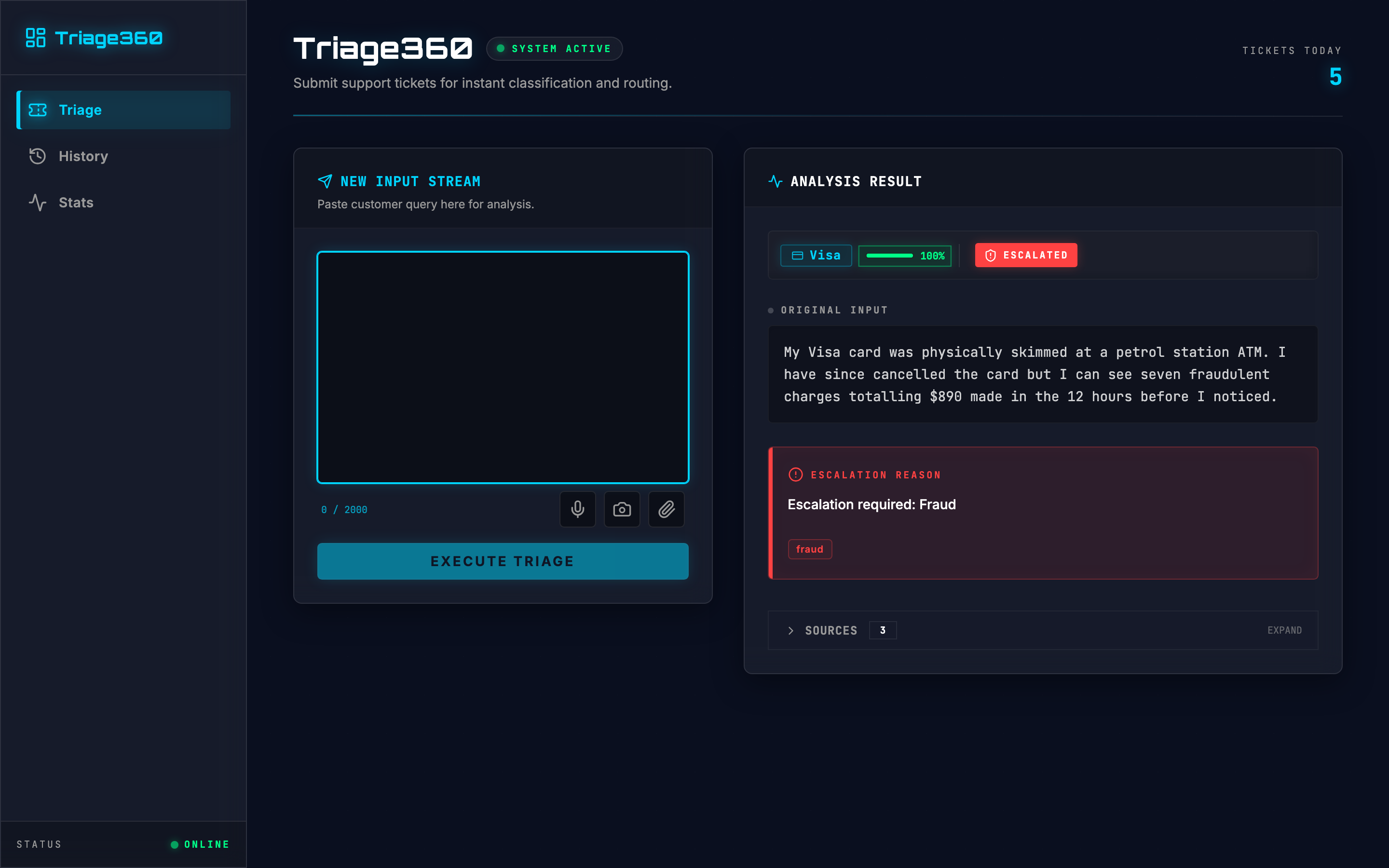
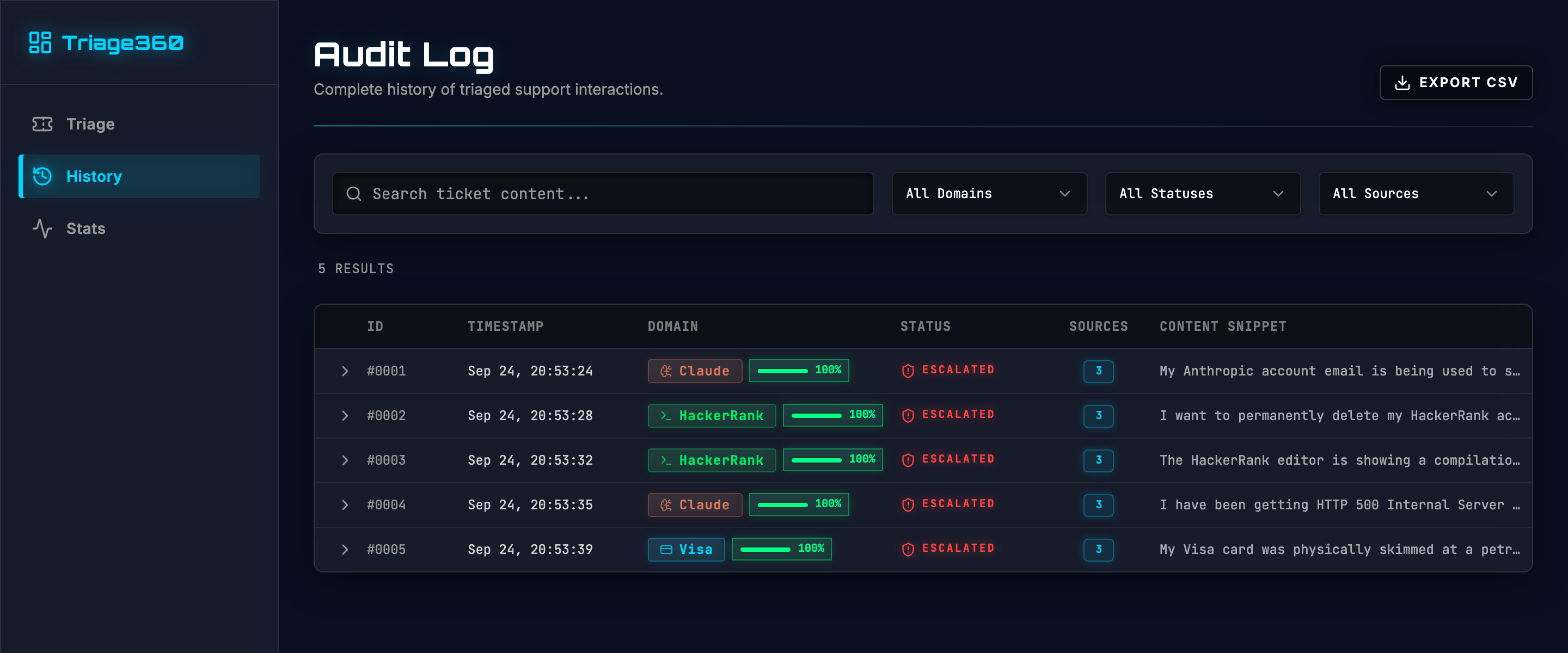
The web application running locally, using sample support tickets from the project repository.
Architecture
Each ticket is classified, checked for escalation risk, and matched to documentation before a response is generated or the ticket is routed to a human. In the web application, retrieval is keyword-overlap scoring over per-domain documentation. Results are persisted so the UI can show ticket history and stats.
Engineering decisions
01
Rule-based escalation before AI generation
Tickets are checked against six risk categories (fraud, billing disputes, account access, platform bugs, legal or compliance, and safety-critical language) before any reply is generated, so risky cases go to a human instead of receiving an automated answer.
02
Responses grounded in retrieved documentation
Replies are generated from support documents retrieved for the classified domain, and the retrieved sources are stored with each ticket so an answer can be traced back to its documentation.
03
Keeping the retrieval prototype separate from the web app
The earlier Python CLI explored TF-IDF with semantic retrieval. The TypeScript web application uses simpler keyword-overlap retrieval over the same corpus, and the two are described separately rather than as one system.